

What is Dissociation?
Have you ever felt numb, not quite there, foggy, or like things aren’t quite real? Dissociation is a common experience in many mental health diagnoses, including PTSD, personality disorders, and autism/ADHD. This is by no means an all inclusive list, and you do not need any diagnosis to experience dissociation. Dissociation is also a spectrum. All of us at one time or another have experienced “highway hypnosis” or been caught daydreaming. But, those of us who have experienced trauma or have other mental health conditions may be disconnected from large periods of their life, and at the extreme end, even experience a fragmented identity.
The structural model of dissociation helps us to understand the different levels of fragmentation and is based on the assumption that everyone has different parts of self (ex. emotions, desires, patterns of behavior) that can be in conflict with each other. When the connection between these is limited, problems can arise.
"You didn't check out. You protected yourself."
Unknown
Depersonalization and derealization
Depersonalization and derealization are two of the more commonly known forms of dissociation. Depersonalization involves feeling like you aren’t quite you. The person in the mirror might feel off. Your thoughts/behavior may also feel wrong even though there isn’t a specific thing you can identify as different. Derealization is similar, but these feelings connect to the world/people around you. Depersonalization and derealization may be experienced simultaneously or separately.
Most commonly, dissociation, including depersonalization and derealization, is part of how your brain has learned to cope with traumatic situations. Mental escapism is sometimes the only thing we can do, and when we do that long enough, our brain may automatically begin to do it without us being aware that it’s going on. The trigger for these “random” moments may be chronic underlying stress, a trauma-versary you forgot about, or being in a similar season or setting to the times when traumatic things happened. You may not always dissociate in response to these, but it’s important to note them for those moments when you cannot identify the trigger!
How Dissociation shows up in different diagnoses
Although trauma is often at the root of dissociation, it isn’t always. Dissociation shows up in many mental health disorders, in varying degrees of disconnect. We must remember that each person is different and that each level of fragmentation is not completely defined by the diagnosis.
Depression- and Anxiety-Related Dissociation
Depressive and anxious dissociation is not inherently trauma-related, but rather a way that the brain attempts to cope with the constant negative feelings associated with these diagnoses. While it is not required to qualify for the diagnosis, it is another way that symptoms may present. This may look like being unable to get out of bed, “going through the motions of life,” constant negative thoughts towards self-worth, and rumination on areas of anxiety or insecurity.
Neurodivergent-Related Dissociation
Within autism and ADHD, you may be dissociating due to issues with executive function (a set of cognitive skills used to manage daily tasks/goal setting, including cognitive flexibility, inhibition control, and working memory) or sensory processing. This could look like becoming hyperfocused on a task, zoning out or being distracted by other thoughts in a lecture or activity, or becoming dysregulated in response to bad sensory stimuli (like chalk on a chalkboard).
Addiction-Related Dissociation
Eating disorders, substance abuse, and other addictive behaviors are other common place that dissociation arises. All serve as a way to disconnect from the mind and body by focusing on something else. Binging and restrictive food behaviors are often a means of self-numbing. Extreme alcohol, drug use, and gambling are other common forms of self-medication that keep us distracted from our inner emotional state.
Trauma-Related Dissociation
In single-event PTSD, dissociation is less likely than with complex trauma (C-PTSD), but it may still arise. You may find yourself feeling panicked, out-of-body, or back in the traumatic memory. This may include flashbacks in which you see the event again, or you may “only” be experiencing the emotional memory.
In personality disorders or complex PTSD (multiple or ongoing traumatic events), you may be dissociating from certain parts of self, emotions, and thoughts that would usually guide how you judge a situation. For example, someone may find themself automatically reacting to perceived abandonment, causing them to lash out or attempt to fix the situation, without the full thought/judgement that they would usually approach it with. The parts are not so separate that they have their own distinct identity, but they often feel in conflict with each other. You may find yourself wondering why you reacted the way you did when emotions settle, as it doesn’t feel congruent with your normal life self.
These models of dissociation (described in detail below) may also help you better understand your parts or specific dissociative experiences. All represent the different protective responses we naturally have as humans, and the level at which fragmentation influences their ability to maintain connection with each other and have a shared sense of identity. Here is some quick vocabulary to understand the terms used:
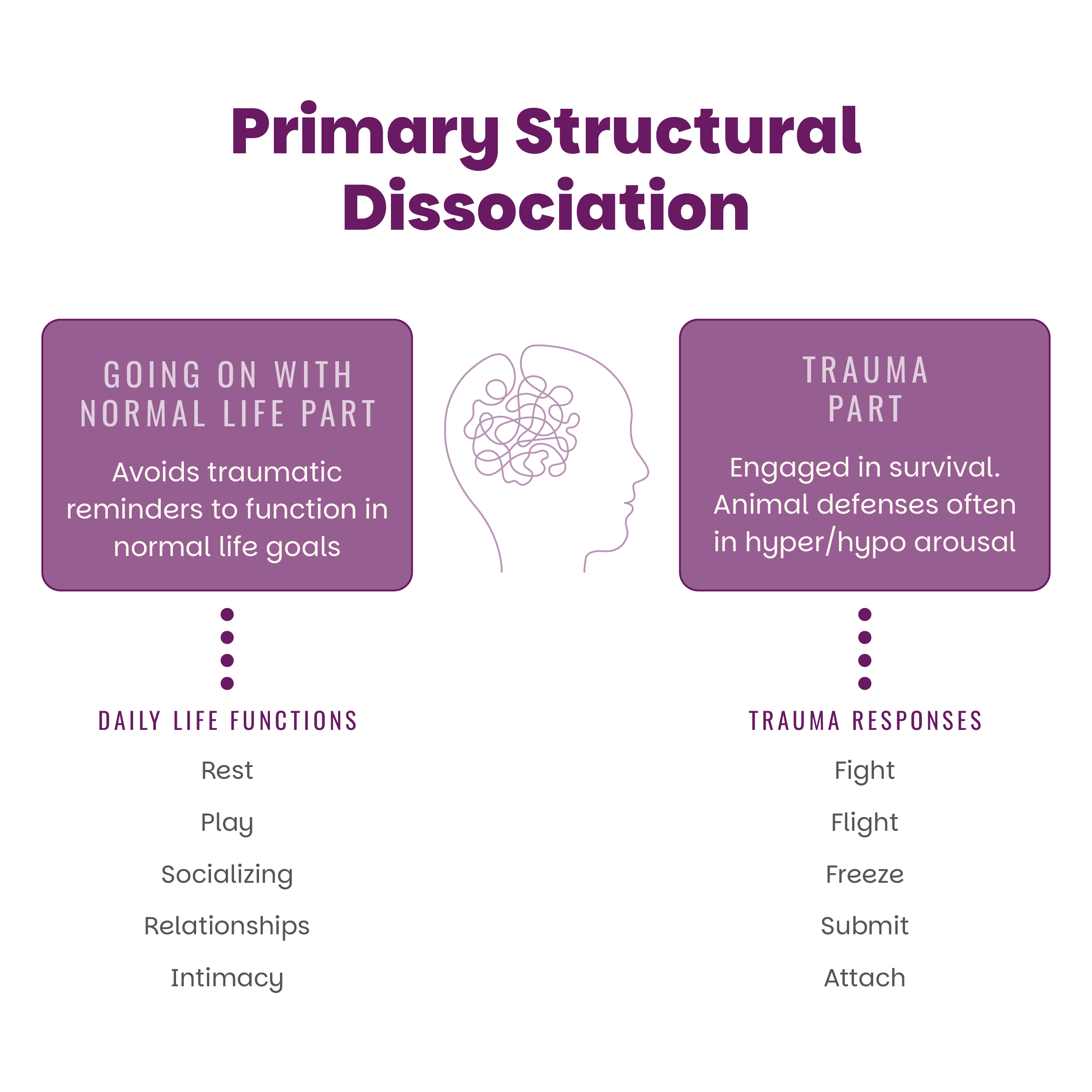
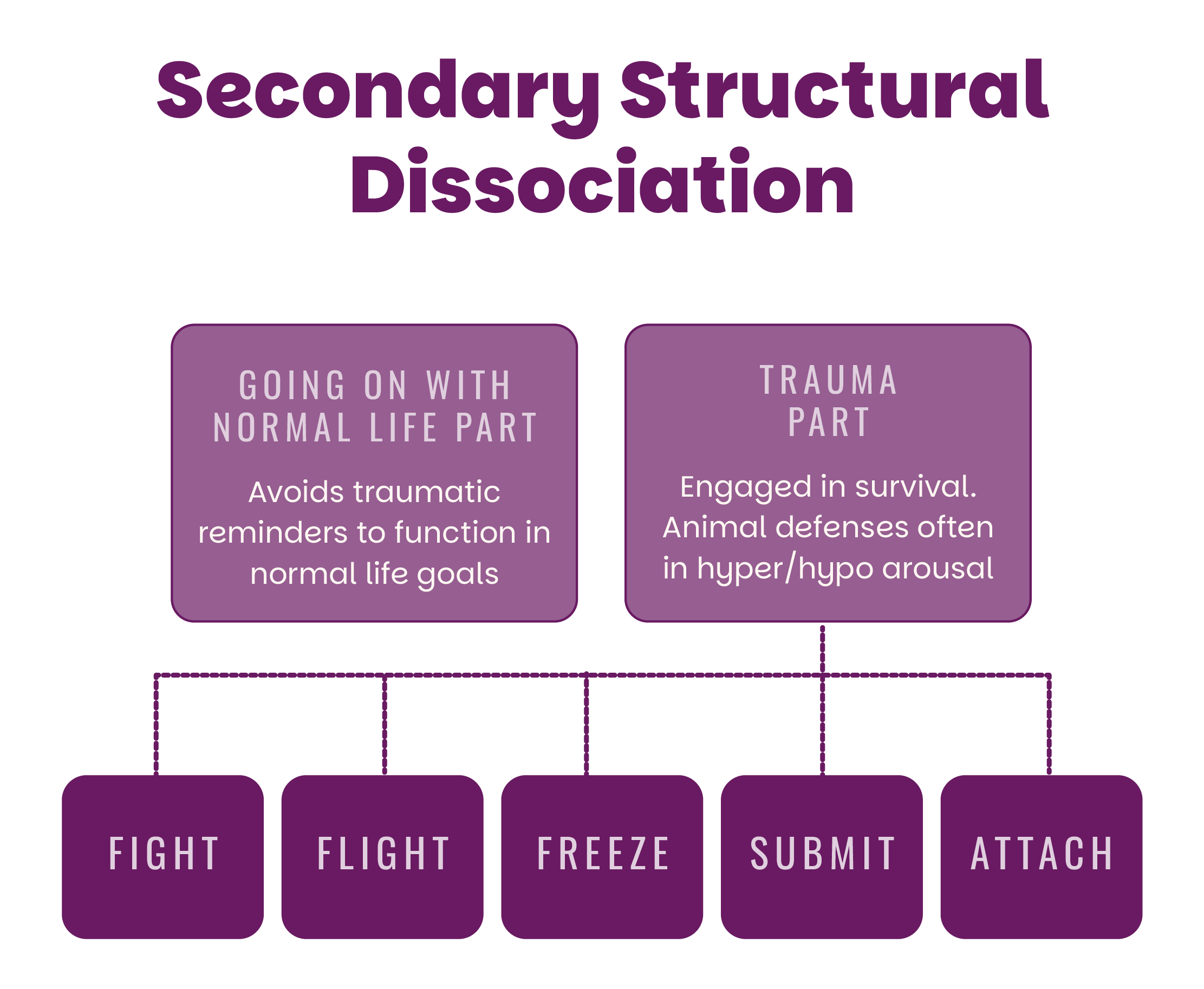
“Going on with normal life” self: The “you” that goes about daily life, the one that others in your life probably know best, the part of the personality that has been disconnected from the traumas on some level in order to survive. This part occupies the pre-frontal cortex and has more ability to regulate emotions and access executive functioning skills
Fight: A protective response that can manifest as anger, verbal aggression, controlling behaviors, and occasionally physical aggression
Flight: A protective response that can manifest as running away, avoidance, procrastination, or mentally checking out
Freeze: A protective response that numbs you to your body, and may manifest as emotional numbness, paralysis, difficulty thinking/speaking, and detachment from your body
Submit: A protective response that acquiesces to others, and may manifest as people-pleasing or fawning behaviors
Attach: A protective response that seeks connection/protection from others and may manifest as people-pleasing, fawning, or reassurance-seeking behaviors
Primary Model of Dissociation
This represents less extreme fragmentation, likely experienced by those with single-event PTSD. Overall, a person occupies their “going on with normal life” part until triggered, which is when the aforementioned trauma responses come online. You will likely remember what happened and why you responded the way that you did, even if once grounded, you recognize it as not how you would react in normal circumstances.
Secondary Model of Dissociation
This represents another level of fragmentation, likely experienced by those with C-PTSD or personality disorders. In this, particular areas of trauma are held by different parts of the brain and respond differently to triggers. Your fight part might come online in a scary situation, soon followed by a submit or attach part that seeks comfort for doing something “bad” that leads to feeling rejected. You will likely remember what happened, but it may be more difficult to understand why you reacted the way that you did.
Tertiary Model of Dissociation
This represents a deeper level of fragmentation, likely experienced by those with OSDD (Other Specified Dissociative Disorder) or DID (Dissociative Identity Disorder). In this case, there may be multiple parts assigned to a single trauma response. Many traumas have been experienced over the course of life and compartmentalized. In this case, you may or may not remember being triggered or how you reacted. You may or may not be aware of the existence of other parts. Parts are also more likely to be experienced as more fully formed personalities or people than in the primary and secondary models.

How do I better manage my dissociative symptoms?
Now the real question, how do I better manage my dissociative symptoms, regardless of level or specific diagnosis? First, seek out a provider specialized in your concerns. Ask if they are knowledgeable about dissociation, neurodiversity, etc. At Spotted Rabbit, we are personally preferential to IFS, ACT, and somatic models, given they focus on building a stronger awareness of personal identity and building a mind/body connection.
Art therapy can be a great tool given that hands-on, creative practices are shown to improve executive function and mind/body awareness. It’s also helpful for those who don’t always have the words, have repeated them countless times to providers, or are still building a sense of safety to share. It also puts the focus on making change in the here/now, allowing you to practice grounding and internal communication skills in session vs “only” focusing on insight.
If you are personally struggling with dissociation, lack of, or incongruence with your self-identity, or just want to understand more about how/why you operate the way you do, feel free to reach out to Spotted Rabbit Studio to start the conversation! We have therapists who can work with you one-on-one or in groups that allow you to practice building connections with yourself/others through art. There is no right or wrong way to get started, so if making art and learning more about yourself is something you would like, this is the place for you!
Curious about how art therapy could support your journey? We'd love to connect! Explore our website to learn more about our therapists, services, and creative approach to mental health care.
There is no waitlist. If you're in the Rochester area, we offer in-person sessions at our Brighton and Pittsford offices, with a third location coming soon. Prefer to meet from home? We also offer virtual therapy sessions.
Whether you have questions or you're ready to get started, reach out and say hello! Call or text us at 585-430-9877 or email hello@spottedrabbitstudio.com.
You can also stay connected by following us on social media or subscribing to our newsletter, where we share mental health resources, creative inspiration, and updates from our community.
Whatever brought you here, you don't have to figure it out alone. Our therapists combine clinical expertise with creativity, compassion, and lived experience to help you explore life's challenges in ways that feel authentic to you. If you're ready to begin your journey, we're here to meet you where you are.
Together, in a relaxed one-on-one setting, we'll help you use creativity to uncover your strengths, explore your identity, and write the next chapter of your story with greater confidence and self-compassion. If you're ready to begin, we're here to create that space with you.
Spotted Rabbit is a fully stocked mixed-media art studio that provides art-based psychotherapy.
We also offer specially curated small-group social connection for children, teens, and adults who are neurodivergent, LGBTQIA+, or who just feel a little bit different.

This post was written by Kit Shulman, LCAT (he/him), a creative arts therapist at Spotted Rabbit Creative Arts Therapy. Learn more about his background and approach on his bio page and to book a session.