If you are autistic, ADHD, late-diagnosed, self-diagnosed, burned out from masking, or tired of talk therapy that feels like it was built for someone else’s brain, you are not alone. You need mental health care that understands sensory needs, communication differences, trauma, identity, and the real exhaustion of trying to function in a world that keeps asking you to hide who you are.
At Spotted Rabbit Creative Arts Therapy, we work with neurodivergent folx every day in creative ways that are affirming and grounded in real life. We know therapy does not have to look like sitting perfectly still, making eye contact, and explaining your feelings in the “right” order. Art therapy can offer more room for your brain and body to be understood, especially when words feel too small, too fast, or too hard to reach.
In this article, we are sharing evidence-informed art therapy approaches that we have seen make a meaningful difference for neurodivergent clients in the studio. We will look at how neurodivergent art therapy for autism and ADHD helps with emotional regulation, sensory overwhelm, identity exploration, masking, burnout, and the process of finding a therapist who actually understands neurodivergent needs.
"Man will begin to recover the moment he takes art as seriously as physics, chemistry, or money."
ERNEST LEVY
Key Takeaways
- The best art therapy approach depends on the person. Neurodivergent art therapy should be adapted to your sensory needs, communication style, energy level, trauma history, and goals.
- Art therapy is not about being “good” at art. Drawing, painting, collage, clay, visual journaling, grounding exercises, and storytelling can all be used to process emotions, understand patterns, and communicate what words may not fully hold.
- Art therapy creates more room for autonomy, communication, and non-verbal expression. Research from the NIH on art therapy and autism suggests creative expression can help neurodivergent folx translate emotions, sensory experiences, and inner thoughts into visual form.
- ADHD and art therapy can work well together. The process is active, visual, and hands-on. For ADHD clients, art therapy may address emotional regulation, executive functioning, transitions, rejection sensitivity, burnout, and the pressure to “just try harder."
- Therapy for autism and ADHD should adapt to the person, not the other way around. Neurodivergent-affirming art therapy makes room for sensory needs, movement, stimming, direct communication, masking, shutdowns, emotional intensity, and different processing speeds.
What Is Art Therapy and How Does It Support Neurodivergent Individuals?
Art therapy is mental health care that uses art-making, creativity, and reflection with a trained art therapist to help you process your inner world. It is not an art class, and no one is sitting there grading your collage or trying to decode your drawing like a secret message. The art is there to help you notice, express, and understand what is happening inside, especially when words feel too exhausting to find.
For neurodivergent people, art therapy can create more room to show up as you are. Maybe talking feels too fast. Maybe eye contact is a lot. Maybe your body needs to move, stim, pause, avoid certain textures, or take extra time before responding. In a neurodivergent-affirming art therapy space, those needs are not treated like disruptions. They are part of how therapy works.
Our art therapists are neurodivergent-affirming and are experts in creating safety, choice, and self-understanding in session. We have seen art therapy in practice support emotional regulation and help with things like anxiety, sensory overwhelm, trauma, burnout, identity exploration, communication, and self-advocacy. Neurodivergent art therapy is a powerful tool for supporting kids, teens, and adults with neurodiversity to process their experiences in a space that is molded to them, not the other way around.
The Unique Benefits of Art Therapy for Neurodivergent Folx
Art therapy can be a powerful force for positive change for neurodivergent folx because it provides a way to process without relying only on direct conversation. Instead of needing to explain everything perfectly, you can use art, movement, texture, color, and reflection to understand your needs with less pressure.
More Ways to Communicate Complicated Emotions or Experiences
Some feelings do not arrive in clean sentences. Art therapy can help you express emotions, memories, sensory experiences, or inner conflict through images, colors, textures, and symbols when words feel hard to reach.
Support for Emotional Regulation and Sensory Overwhelm
Art-making can give your nervous system something concrete to focus on when everything feels too loud, too fast, or too much. In session, you can explore materials and creative practices that help you feel more grounded, then carry some of those tools into daily life.
Space to Move, Pause, Stim, Create, or Process at Your Own Pace
Neurodivergent art therapy here at the studio is affirming and does not expect you to sit perfectly still or process on command. You can move, pause, stim, take your time, or create while you talk, because your body’s way of processing belongs in the room too.
Creative Tools for Exploring Identity, Masking, Burnout, and Self-Trust
Art therapy can help you explore who you are underneath the roles, expectations, and survival strategies you have had to carry. Art therapy for neurodivergent folx can make space for questions around masking, burnout, gender, values, boundaries, and what it means to trust yourself again.
A Less Pressured Way to Look at Big Feelings, Trauma, or Anxiety
Sometimes talking directly about trauma, anxiety, or big feelings can feel like too much too fast. Art can create a little distance, giving you and your therapist something to look at together so you do not have to hold everything alone.
More Room to Understand Your Brain and Body Without Shame
At its best, neurodivergent art therapy helps you slow down and notice what your nervous system is asking for. Our studio is a safe, affirming space where you can start to understand yourself and build support that fits you.
Art therapy for neurodivergent folx offers more than a coping skill. It can offer a place to explore your needs, listen to your nervous system, and make sense of experiences that may have been ignored, mislabeled, or misunderstood for a long time. When therapy moves at your pace and honors how your brain and body actually work, healing can feel less like performing and more like coming back to yourself.
Evidence-Based Art Therapy Approaches for Neurodivergent Folx
NIH-indexed research on art therapy and autism suggests that creative expression can help neurodivergent folx translate emotions, sensory experiences, and inner thoughts into visual form, creating more room for autonomy, communication, and non-verbal expression. That does not mean art therapy works the same way for everyone, but it does suggest that creative, sensory-aware therapy may offer meaningful support. Especially when the therapist is affirming, well-trained, and willing to adapt the process to the person in front of them.
Neurodivergent art therapy for autism and adhd, among other forms of neurodivergence, doesn’t consist of just one technique, and it definitely is not sitting across from a therapist while they silently analyze your drawing. In session with our therapists, art therapy for neurodivergent folx can look different for every person because the best approach depends on your sensory needs, communication style, energy level, trauma history, and goals.
Drawing and Painting for Emotional Expression
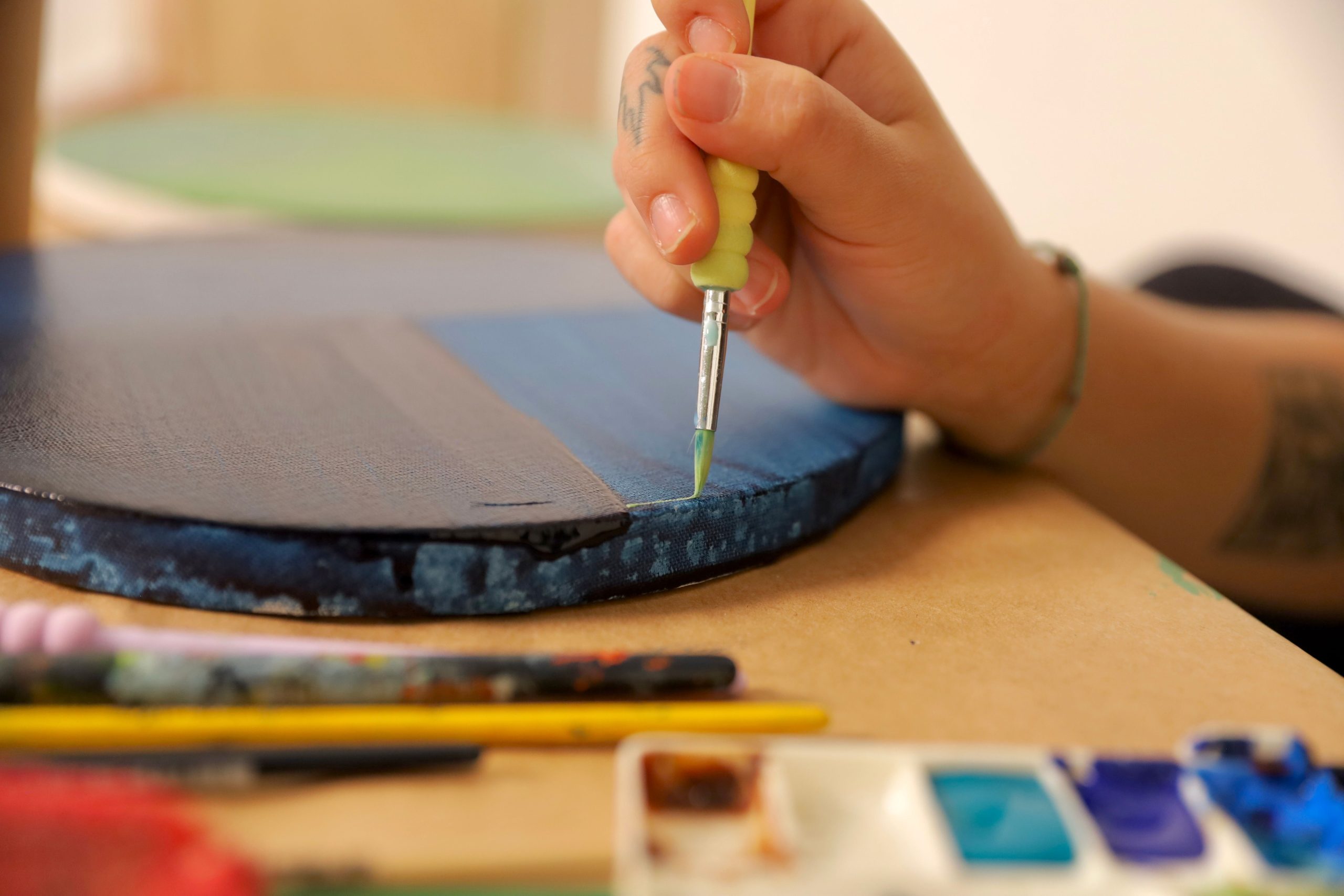
Drawing and painting can help you express emotions, memories, body sensations, or internal experiences through color, shape, line, and movement. You might use bold colors to show intensity, soft lines to track sadness, or abstract shapes to explore anxiety, overwhelm, or shutdown.
Collage and Mixed Media for Identity Exploration
Collage-making can be a gentle form of art therapy because you do not have to start from a blank page. For neurodivergent folx, gathering images, words, textures, colors, and symbols can support identity exploration, masking, burnout, gender, values, and self-understanding.
Clay and Tactile Art-Making for Sensory Regulation
Clay, fabric, paper, and other tactile materials can support grounding, sensory regulation, and body awareness. Squeezing clay, smoothing paper, tearing materials, or working with texture can give your body something concrete to do while your mind catches up.
Visual Journaling for Patterns and Self-Understanding
Visual journaling can help you track moods, shutdowns, meltdowns, sensory overwhelm, executive functioning patterns, or emotional shifts over time. You might use colors, symbols, short phrases, drawings, or repeated marks to understand your week, your energy, or your nervous system.
Mask-Making and Identity Work for Unmasking
Mask-making, self-portraits, and symbolic art can help you explore masking, including the difference between the self you show the world and the self that gets hidden, protected, or misunderstood. In neurodivergent art therapy, unmasking means getting curious about what feels authentic, what feels protective, and what parts of you deserve more care.
Art-Based Grounding Exercises for Overwhelm
Art-based grounding exercises can help bring your nervous system back into the present moment. Repetitive lines, color fields, pattern-making, contained drawings, or simple mark-making can give your brain and body a steady, creative rhythm to return to when you feel overwhelmed, overstimulated, or disconnected.
Narrative and Image-Based Storytelling for Processing Experiences
Narrative art therapy approaches use comics, symbols, maps, timelines, or visual stories to process relationships, trauma, transitions, identity, or parts of yourself that are hard to explain directly. Image-based storytelling lets the process be more flexible, layered, and honest.
The best neurodivergent art therapy approaches are the ones that meet you where you are. In neurodivergent-affirming care, your therapist should adapt the process so you can move, pause, stim, choose materials, communicate directly, and work at a pace that feels possible.
Art Therapy for Autism and ADHD
Autistic and ADHD people often carry years of being misunderstood. What gets labeled as “too sensitive,” “lazy,” “dramatic,” or “not trying hard enough” may actually be sensory overwhelm, burnout, shutdown, executive functioning struggles, or a nervous system doing its best in a world that was not built with neurodivergent needs in mind. You might have been researching "therapist for adult autism" or "art therapy for autism near me" and ended up here at Spotted Rabbit Creative Arts Therapy - and we can proudly say that you could not be in better hands.
Our art therapy for autism and ADHD offers a flexible, affirming place to explore those experiences without trying to become more neurotypical. Our goal is to help you understand your needs, build self-trust, and find supports that work with your nervous system in session and out in the world.
Art Therapy for Autistic Kids and Teens
Neurodivergent art therapy can give autistic kids and teens a creative space to express feelings, process sensory overwhelm, and build self-understanding without needing to explain everything in words. In session, we may use art-making, play therapy, structure, and sensory-aware support to help young people feel understood, respected, and less alone in what they are carrying.
How ADHD and Art Therapy Can Work Together
ADHD and art therapy can work together because art-making gives your brain something active, visual, and hands-on to engage with while you process what is happening inside. Sessions may include visual mapping, color-coded emotion tracking, collage, movement-based art-making, grounding materials, or creative prompts that help make abstract thoughts feel more concrete.
Integrating the principles of ADHD and art therapy can help clients make sense of their internal experiences by providing sensory engagement that aligns well with attention variation and hyperactivity. This synergy allows the active process of creating art to serve as both a therapeutic outlet and an executive functioning tool.
ADHD Support Without the “Just Try Harder” Shame
ADHD is not a motivation problem or a character flaw. ADHD and art therapy can offer a flexible path for exploring focus, motivation, overwhelm, and executive functioning without shame. It offers structure, movement, color, and hands-on materials to help you notice patterns around focus, time, overwhelm, procrastination, rejection sensitivity, and burnout without turning therapy into another place where you are expected to perform.
Neurodivergent Art Therapy at Spotted Rabbit Creative Arts Therapy
If you have spent years trying to explain your brain, hide your needs, or make yourself easier for other people to understand, therapy should not ask you to keep doing more of the same. You deserve care that gives your nervous system room to slow down, your identity room to exist, and your story room to unfold at a pace that feels safe.
Neurodivergent art therapy can help you notice what you need, understand what you have been carrying, and build support that works with your brain and body instead of against them. Whether you are autistic, ADHD, queer, trans, nonbinary, chronically ill, burned out, trauma-impacted, or still figuring out what language fits, you do not have to come in with everything perfectly explained.
If you’re interested in learning more about neurodivergent art therapy, we're here to listen. Spotted Rabbit Studio has several therapists trained in neurodivergent-affirming therapy (including for autistic, ADHD, and AuDHD folx) and can work with you to get down to the root of the problem through a blend of talk therapy and artistic creativity. Our art therapists also bring lived experience, so you can feel safe in knowing that you will be understood and that you are not alone. If you are looking for art therapy for neurodivergent folx that feels creative, collaborative, and deeply human, we would be glad to help you start.
No Waitlist. Reach Out Today. Call or text 585-430-9877, or contact hello@spottedrabbitstudio.com to learn more about starting expressive arts therapy with Spotted Rabbit Creative Arts Therapy. The canvas is ready, and we will get back to you immediately.
If you’re a Rochester local, we have offices in Brighton, Pittsford, and, coming soon, a third studio location! We also offer virtual sessions. Check out our website to connect!
You also may be the perfect fit for our High-Masking Neurodivergent Adult Art Group. This class is offered quarterly and is for adults who are high-masking, have low support needs, or are late-diagnosed autistic, ADHD, or AuDHD. Not diagnosed? You’re welcome here, too!
We’ll use open-ended and directed art-making to actively work on identity development, emotional expression, and social connection while learning more about the ways autism, ADHD, and AuDHD impact our emotions, thoughts, and behaviors. As always here at Spotted Rabbit, our goal is to help folks embrace authenticity and build a life aligned with their own personal needs and values.
If you have moderate or high support needs, please check out our Art Class at Monroe. Pre-registration is open!
We also share updates and resources through our newsletter and social channels if you’d like to stay connected.