
We at Spotted Rabbit Studio support individuals who suffer from persistent intrusive thoughts. Through our work, we’ve noticed that intrusive thoughts come in many forms, varying significantly depending on the individual. While not limited to any specific diagnosis, they are often associated with PTSD and OCD. When these thoughts occur consistently, they often cause immense distress, disrupting the lives of those who experience them and negatively impacting interpersonal relationships.
What Are Intrusive Thoughts?
Intrusive thoughts are a fairly common occurrence; most people will experience a multitude of intrusive thoughts in their lifetime. These are often defined by appearing suddenly and causing distinct discomfort. For example, you might be driving one day and suddenly get hit by an overwhelming vision of you swerving into another car’s lane. Maybe you're sitting down with your family for dinner and suddenly see yourself flipping the table. For most of the population, these thoughts are fleeting, forgotten shortly after they occur, but for a select few of us, they become stuck, causing immense distress.
Common Types of Intrusive Thoughts
Violence: Often revolves around the idea of hurting oneself or others. (Ex. Thinking of punching your boss during your quarterly review)
Sexual: Can revolve around one's own sexuality, or undesired sexual thoughts about others, including partner infidelity. (Ex. “What if I’m secretly gay/straight?”, “What if they’ve been secretly cheating on me?)
Specific Phobia: Those with specific fears, such as heights or spiders, will often experience intrusive thoughts related to their fear. (Ex. Thinking about a spider being on your pillow when you're about to fall asleep.)
Shame or Self-doubt: These are often experienced as a feeling of inadequacy or as a visceral recollection of past humiliations we’ve experienced. (Ex.“ What if I’m a terrible worker, and they’re about to fire me?” Or recalling a time you were made fun of for having acne.)
Medical Concerns: Often revolve around the potential of getting sick or the body breaking down. (Ex. “What if I secretly have cancer? Or “What if that doorknob was covered in germs, and I catch a cold?”)
How Thoughts Escalate
A strong emotional reaction is the key factor in elevating a passive thought into a persistent one. For example, most individuals would take the idea of flipping a table as strange, but carry on with their day as normal. Some of us interpret these thoughts as a reflection of our character, sparking shame or disgust. Additionally, some might also interpret inappropriate thoughts as a form of intent, making them question their capacity for wrongdoing. When we meet intrusive thoughts with such strong emotional reactions, we instinctually push back against them, causing our brains to latch onto the idea.
Mindfulness and Accepting Intrusive Thoughts
The easiest way to prevent an intrusive thought from escalating is to meet it with acceptance. This allows the thought to pass freely through the mind without sparking a visceral reaction. Here at Spotted Rabbit, we utilize arts-based mindfulness practices to help you remain grounded in the present moment. This empowers you to accept thoughts without judgment, which in turn improves your emotional awareness and greatly reduces the anxiety these thoughts invoke. Our team of qualified clinicians will work alongside you, providing support in sitting through these intrusive thoughts, while avoiding being swept away.
How Art Therapy Supports Mindfulness
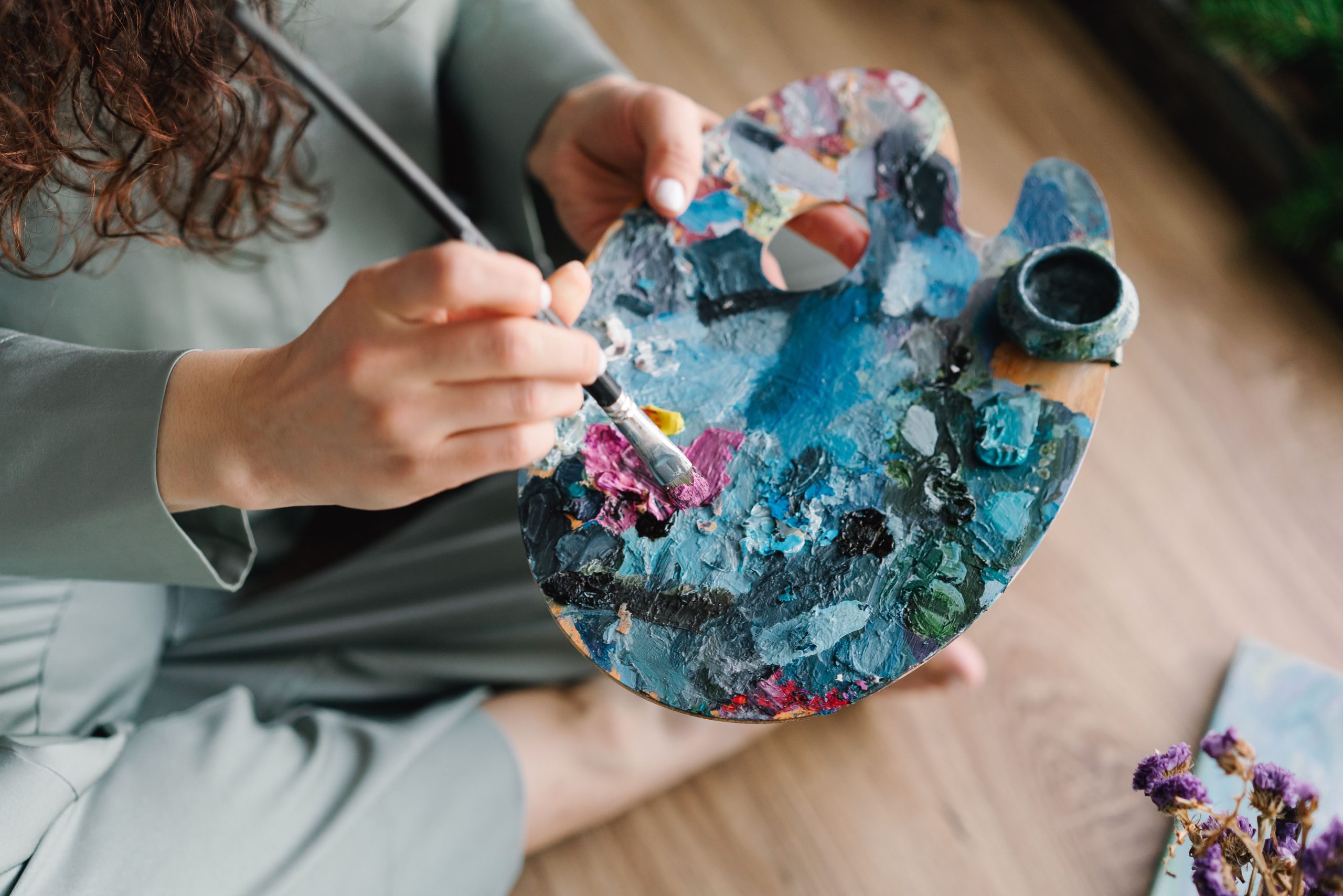
Traditional Mindfulness approaches utilize meditative practices that strengthen the user's connection to their emotions and bodily sensations. The creation of art is widely accepted as a powerful meditative tool, and our clinicians use art-making itself as a way to practice mindfulness, allowing you to connect to and process your internal experience without the pressure of having to formulate it into words.
The goal of mindfulness-based art therapy differs from traditional art making, as it emphasizes the process of creating rather than a final product. You're encouraged to stay grounded in the present, feeling each brushstroke and line drawn. This allows you to engage in self-reflection while remaining grounded. Having the body engaged in art making gives the mind less space to spiral, allowing you to process trauma/discomfort without the interjection of unhelpful internal dialogue.
"Art can permeate the very deepest part of us, where no words exist."
EILEEN MILLER
Additional Benefits of Mindfulness-Based Art Therapy
Through art-making, your brain manually shifts away from everyday stressors, allowing you to decompress and relax. Beyond that, engaging in creativity helps you to observe your internal dialogue, noticing thought patterns as an observer rather than an active participant. Through this observation, you begin to increase your emotional awareness. With practice, this learned awareness begins to seep beyond traditional art-making, providing you with the necessary skills to meet intrusive thoughts objectively.
Ways to use art mindfully at home
Mindful Photography: This is a practice in staying in the moment. Through this technique, you foster a connection with your environment by means of a camera lens. Think about environments that are meaningful to you. Next time you’re there, try pausing to take a picture that captures the experience, reflecting on why that place/moment is personally significant.
Zen Tangles: This is a technique that utilizes repetitive pattern making to create an abstract piece of art. The process is fairly simple. You start with a blank sheet of paper, breaking it up by creating strings (lines) throughout the page, forming sections. Once you have all your sections in place, you simply use a pen to fill each space with repetitive patterns.
Art Journaling: Journaling is a powerful tool for self-reflection. Art journaling builds upon that idea, encouraging the artist to remain present in expressing an experience rather than attempting to make a masterpiece. This process allows space to process emotions and experiment with various forms of self-expression. When engaging in art journaling, it is best to focus on how you feel making each page, rather than having a desired outcome.
Intuitive Collage: While traditional collage may follow a specific theme or aesthetic, Intuitive collage encourages you to bypass the analytical mind, choosing components based on the feelings they invoke. This process encourages deep self-reflection, allowing you to express emotions by projecting them onto the page.
If you’re looking for more support in navigating intrusive thoughts and OCD, Spotted Rabbit Creative Arts Therapy can help! We have several therapists who not only have obtained education and training but also bring lived experience and can work with you one-on-one in a relaxed setting.
Intrusive thoughts can feel isolating, but support is available. Our therapists combine clinical expertise with creativity, compassion, and evidence-based care to help you explore your experiences, create space from overwhelming thoughts, and develop tools that feel authentic to you.
Whenever you're ready, we'd love to connect. Reach out and say hello.
If you’re a Rochester local, we have offices in Brighton, Pittsford, and, coming soon, a third location! We also offer virtual sessions. Check out our website to connect!
We also share updates and resources through our newsletter and social channels if you’d like to stay connected.

This post was written by Evelyn Varlan, LCAT-P (she/her), a creative arts therapist at Spotted Rabbit Creative Arts Therapy. Learn more about their background and approach on her bio page, and to book a session.